Tuesday, 30 June 2009

Plug

Man with a Movie Camera album coverImage via Wikipedia

As you may or may not know, I have the pleasure to work for the Middle East's first technology specialised public relations and communications agency, Spot On Public Relations. I don't often blog directly about work stuff, although my work obviously informs many of my opinions, but I'm going to talk shop for a second here.

Over the years, Spot On has moved from being a pure-play tech and telecom agency to encompass non-tech clients, from 'Freej' originators Lammtara through Virgin Megastores to publishing company ITP and media consultancy DMA. We still retain tech clients, of course, including IBM and Lenovo, as well as my favourite client (oddly enough), printer company Oki Printing Solutions. And we work with a lot of other companies too, from hotels through to mining and finance through to consumer electronics.

One of the things that's started to happen at work, something that has been a pleasant surprise, is that the old tech heritage has come back to inform how we work with a new wave of clients who are most definitely not technology companies, but who are using technology in their work - increasingly in their communications work. When Spot On started, the Internet was a new, and often regarded as threatening, phenomenon in the Middle East and we were very involved in arguing the case FOR the Internet - it's something that resonates with many conversations I have today, believe me.

Social media, you may have noticed it's taking up more and more of my thinking and even blog posting (And yes, I have had complaints), but it is starting to drive some very interesting ideas for us - increasingly in line with my personal dislike of 'big business' and the ways that 'big business' has been behaving.

I like the idea of companies being more open to communicating with the little guys, actually talking to their customers rather than glibly slapping 'customer-centric' on their brand values and then handing down the call centre to the nearest monkey. I like the idea that customers and companies could actually work together to make things work better - because the customers want to be involved and the companies are willing to listen. I like consumers having voice. (You may have noticed!)

I think we're heading towards more of that stuff and it excites me. Sorry, that's the geek in me showing through.

Anyway, this is all a thinly disguised plug for you to go join Spot On's fabby Facebook group, which you can subscribe to if you want to get more 'inside track' on the stuff we're doing with clients and in the social media space, as well as links to things like interviews and articles from Spot On people and the people we work with in our 'ecosystem' of like-minded partners.

Also, if you've a mind to, you're more than welcome to subscribe to a few of Spot On's other 'social media' resources:

Twitter. The Spot On Twitterfeed tends to focus on sharing news of interest to those who follow media, journalism, new media and Internet innovation. It's quite popular.

Netvibes. Arguably one of the most useful RSS readers, Netvibes allows you to aggregate content from multiple sources, from blogs through to newswires and even sources such as Twitter and Google Alerts. Spot On's public Netvibes page is a great 'one stop' resource for you to swing by every day and check out pretty much everything that's happening in Middle East media, journalism and social media.

Delicious. This is another strong media-related resource, where we basically share our bookmarks of interesting stories that are media, PR and journalism related. Again, quite a powerful resource for anyone that wants to get a fast snapshot of what's happening in these areas across the Middle East.

We use a range of other social media platforms for a number of purposes, audiences and clients - but I thought these might be interesting/useful to many of the people who swing by this blog.

[EndPlug]
Reblog this post [with Zemanta]

The Amateur Anthropologist

http://teachpol.tcnj.edu/amer_pol_hist/fi/0000...Image via Wikipedia

I discovered Google Silences yesterday. What’s a Google Silence? It’s when you’re having a big fat old argument with a colleague that’s degenerated from debating solid, intelligent, factually based arguments into ‘Is so!’, ‘Isn’t so!’.

It's at this point that the person you’re arguing with goes suddenly and terribly quiet.

Why?

Because they’re Googling the topic you’re arguing. A Google Silence is followed by two possible outcomes.

“Ha! I OWN you, punk!”

Or

“This is a stupid argument anyway and I think we should move on.”

Reblog this post [with Zemanta]

Monday, 29 June 2009

Tortuous

A crowd of people returning from a show of fir...Image via Wikipedia

Here's something I think is worth sharing. It came to me (and therefore to you) by a tortuous route, I found the link on a comment to an article on Australian marketing uber-blog, Mumbrella (sorry Tim, can't be arsed with the caps and things). But that's how the Internet works, no?

It's the story of how the UK's Guardian newspaper crowdsourced a complex data mining job, using its online readers to help it sift through hundreds of thousands of pages of public records. By making the whole exercise accessible and enjoyable to the public, The Guardian effectively managed to arrange for something like 35,000 people to help intelligently sift through over 170,000 pages of public records unearthed by the great Commons Expenses Scandal. The result was that The Guardian managed to comb 170,000 pages of data in 80 hours, extracting the valuable stuff for its journalists to work on.

It's here. The site, Harvard's Nieman Journalism Lab, is a must-add for your RSS feed if you have any interest at all in the evolution of journalism in the digital age.

I love this case study because it's a really smart application of technology in the spirit of the IBM PC and the Toyota MR2 (two of my favourite things, both originally cobbled together by inspired innovators on shoestring budgets raiding their companies' parts bins). I love it because it's a witty and smart piece of journalistic initiative.

But most of all, I love it because it shows how much more powerful you are when you enlist the help of your customers in the development of your product - which means respecting your customer enough to believe they are worthy enough to begin to possibly understand the arcane intricacies of your unique and difficult profession. Calling for feedback, input, insight or participation from a wider commuinty extends your reach beyond your own organisation's staffing capabilities and brings a wider range of heads to a problem - sometimes solutions to a problem can come marvellously quickly from the uninvolved. It has the potential to broaden your capability to innovate, creates a stronger sense of connection and ownership from customers and folds marketing neatly into product development.

The article on Mumbrella was, incidentally, this one, where News Ltd's editorial director is being a goof about Twitter.

Reblog this post [with Zemanta]

Friday, 26 June 2009

The Monster is Dead

Inconsolable Grief, by Ivan KramskoyImage via Wikipedia

So Michael Jackson's dead. I had to switch off the television to stem the tide of grief. It doesn't seem more than ten minutes ago we were all being entertained by the sight of him dangling children over balconies, facing charges of child molestation and struggling to cope with a mountain of debt from an insane lifestyle that his ailing career could no longer maintain. The world gasped as his increasingly macabre visage leered out at them, caked in make-up and scarred by surgery after surgery, a grotesque mannequin piping platitudes in a ridiculous, squeaky-soft voice.

He died two weeks before the massive series of 'comeback' concerts, a 50 year-old man rehearsing, no doubt, to push himself through punishing routines that would defeat a 20 year-old as he put everything he had into that all-consuming gamble to try and win over the world that had turned its back on him. We can only wait and see if it's confirmed that he rehearsed himself to death.

The villagers chanting 'Kill the monster' as they marched on the castle with their burning brands are now clamouring to get in front of the cameras and wail about how they missed the monster and how he wasn't a monster really, but a globe-spanning entertainer that brought joy to millions and whose loss will be felt by the whole world.

And I sat there wondering why these people who had so much love for Michael had stood by as he sank into penury, turning away from him and tutting at the freak show. The outpouring of saccharine grief was, indeed, too much for me to bear.
Reblog this post [with Zemanta]

Thursday, 25 June 2009

Geek

Ask.com anti-Google campaign on the London tubeImage by Larsz via Flickr

Some side effects from this morning's Business Breakfast slot, with no particularly massive point to make, it's just that I found them interesting. But then I'm a geek, no?

Google is the place where 30% of the Internet goes every day - and it spends an average of 8.5 minutes of that day on the site. As we know, those minutes are spent looking for stuff and clicking on the results - including those lovely, lucrative little Adwords. In fact, Google's Q1 2009 revenue was equivalent to the entire US ad spend on print media. Not bad for a few clicks.

In fact, Google's revenue is equivalent to something like 17% of total global TV advertising spend ($123 billion according to Informa). That's not bad for a single provider, no? It's certainly bigger than any single network. Google's pretty good at growing stealthily wealthy, actually.

Ranked #4 globally by Alexa, Facebook currently gets 19% of the Internet's eyeballs every day, BTW. Interestingly, people spend over four times as long there, though - an average of 25.3 minutes a day are invested on Facebook.

The time people spend on Google appears to be a little more productive, however, Facebook's revenues for 2008 were $350 million.

Twitter's revenue - and, indeed, its revenue model remains pure speculation...
Reblog this post [with Zemanta]

Wednesday, 24 June 2009

When Twitter Falls Apart

Mount Damavand, Iran.Image via Wikipedia

Some commentators are now, quite properly, pointing to the very real failings of Twitter as an ongoing news source on the demonstrations taking pace in Iran.

This chap, Maximillian Forte, link kindly provided in a comment to this post by Graeme Baker, is certainly in that camp and provides a strong and lucid viewpoint.

It's perhaps interesting to look back over events in Iran and how Twitter, as a community, responded.

In the first phase, Twitter clearly led the news agendas of mainstream media, providing on the ground witness and a diversity of updates that caught the popular imagination - including triggering the #CNNfail protest that eventually forced the channel to react publicly and defend its woeful programming in the face of an important series of events.

In the second phase, Twitter started to clog up with useless ReTweets (RTs) of stale information as the public mood drove the need to be somehow participatory. The students in Iran who had been Tweeting updates fought to keep their links to the world open, but were battling not only those who wanted to silence them but trying to have their voices heard in the babble.

With the almost hysterical outbreak of wannabe participants came disinformation - calls to change your location to Tehran to protect the student Tweeters meant that now anyone could 'Tweet from Tehran' - and so more chaff joined the flow of information. That was made worse by a call to remove the ID of anyone you RTed in order to protect them - effectively depriving any information of a source.

If you weren't in the game early or close to people on the ground, and therefore following the right people, by now you were getting some pretty duff information - and fifteenth hand information, at that.

Phase three has been the complete breakdown of Twitter as a news source. The 'turn your avatar green' movement is a symptom of this. Vested interest has meant that clear disinformation is now being sewn into Twitter, with Tweets claiming that Arabs have been brought into Iran, stabbing people's sisters and so on.

But then Twitter was never meant to be a news resource and, I think most people would agree, can not be relied upon as a news resource beyond the fact that, as a platform, it lets fresh eye witness news travel fast. That first phase is where Twitter is potentially solid gold and where it has indeed led news agendas - not only inTehran, but also in the Mumbai bombings and other incidents.

Once it descends into fads and conversation, there is no news value in Twitter - as, indeed, there is rarely news value in conversations. That's just chattering - what the service, in fact, was built to do. Pointing to the chattering then squeaking about how useless Twitter is doesn't mask the fact that Twitter brought the streets of Iran to the desktops of millions of people across the world.

And CNN didn't.


Reblog this post [with Zemanta]

Tuesday, 23 June 2009

A Nony Mouse

Wood mouse (Apodemus sylvaticus)Image via Wikipedia

Whenever I get an anonymous comment on the blog, my heart does a little sinking thing.

Anonymity is the Internet’s great gift and at the same time its burden. It allows people the freedom to be who they truly are, to shake off the bounds of convention and propriety that tie down our everyday lives. It lets people share opinions they otherwise could not voice, speaking freely about their employers, their relationships or their governments. It lets people confess and share, unburden themselves and shout joy without having to worry about reactions, restrictions or repercussions.

It also lets people be mean, shitty and petty without ever having to worry about having to face their victims. It makes people into cowards.

I made the conscious decision to blog and express my own opinions under my own name (I think the only person to do so in the UAE at the time, but I’m sure I’ll be corrected on that one!). That’s something I’ve always done – as a journalist and as a commentator, columnist and contributor to TV, print and radio. I might be wrong, I might be a gob, I may well be a complete arse, but at least I’m out there taking it on the chin in public.

People that don’t have the strength of character to express their negative opinion or unpleasant reaction in the same way do irritate me. If I can be a brave boy, so can you.

Rarely have I seen anonymous comments on blogs justified by a reasonable fear for personal safety – more frequently they’re driven by vested interest. A distressing number of people representing companies still comment anonymously on blogs thinking that they can’t be ‘found out’. That is not the case – I’ve said this lots before – people who host websites, including blogs, can gain access to an amazing degree of highly granular information on visitors who are almost invariably traceable through their IP.

It’s not always about vested interest, of course. Sometimes anonymous comments are just from people who can’t be bothered to do the log-in thing. And sometimes they’re from people who are setting out to crap in someone else’s cornflakes but who don’t have the guts to do so in person. This last is the one that gives me the sinking feeling – a little slice of snarky nastiness dumped into someone else’s life by a person that doesn’t have the guts to do so openly.

Which is why I never bother taking up the conversation with anonymice. Just thought I’d get that out of the system, folks...


Reblog this post [with Zemanta]

Sunday, 21 June 2009

The Machines are Taking Over

HAL's iconic camera eye.Image via Wikipedia

Etisalat, the telephone company that likes to say 'ugh', has decided to come to my aid in what has been a workmanlike and drab start to the week and introduce a spangle of special fun into my life.

The Directory Enquiry Service (181 to you, mate) has been cut over to an almost but not totally non-functional IVR system. That's Etisalat's secret - not to be utterly useless, just almost utterly useless. It's so much more devastating to give the subscriber a glimmer of hope before dashing it, I find, than giving no hope at all.

Now when you call 181 you get asked to press * for English. When you do, it talks Arabic to you. This is pretty special stuff, but it's only a start of a special journey into the unknown. You are given a list of things you could want like hotel, restaurant or pigeon fancier's club. You have to either say one of these things or say 'other'. The system will then automatically misunderstand you. This is disintermediation at its best - to replace a human that rarely understands what you want with a machine that never understands what you want.

When you say 'other' you get asked for what you want. So you say, 'Dirigible Repair Specialist' and the IVR system, in a female Hal9000 voice, says, 'Do you want Peter's Patent Pringle Painters Llc? Yes or no.'

So you say 'No.'

And the IVR says, 'Which Emirate are you looking for?'

And you say 'Dubai.'

And then you get an operator who agrees that yes, the machine is totally useless and yes, everyone's been whingeing and yes, he can help you. He sounds amused. As am I.

I called back to get the scripts right for this blog, but I got a human this time 'round, who assured me that yes, she was human and yes, she could help me. She was quite affronted when I told her I had actually wanted the machine so I'd call back for it...

(The system now cuts to IVR when the operators are busy, but only for landline callers, BTW)

(PS: I'll let y'all know when I get the search hit for 'Dirigible Repair Specialist')
Reblog this post [with Zemanta]

Thursday, 18 June 2009

Wheels Within Wheels

IMG_3142
Part of this week's rich debate around Twitter and social media has been about who you can trust online.

That's an interesting debate when you take the 'turn your Twitter avatar green' service that a number of Twittering types have started to use. The idea's nice and simple - a one-click process via the helpiranelection website will turn your avatar green so that you can demonstrate your support for Mousavi's backers in their call for a recount.

The chap behind helpiranelection is Arik Fraimovich. When he's not helping people to show solidarity with Iranian political movements, he's a software developer. I have to note that, while he is not now, he has previously worked for the Israeli Ministry of Defence. That doesn't mean to say he is aligned to the MoD or is in any way carrying out its will. But the fact that an Israeli with government links is behind a 'back Mousavi' Internet scheme will sit uncomfortably with many in the Arab World, let alone in Iran itself.

I am quite, quite sure that Arik's idea was well intentioned. But 'going green' is, I think, an Iranian choice to make.

Thanks to 'Party Boy'... :)

Reblog this post [with Zemanta]

Paris Hilton Dumb? Hell No!


It's going to be a long, hot summer, people. Not only do we have the tide of infinite-eyed yellow evil to contend with, popping up all over the place ready to embrace us in those little open arms (so that it can tear our throats out and feast on our livers), we've got a localised outbreak of Paris Hiltons.

Ably assisted by a number of drooling morons in our local media, Paris is going to be spending the next three weeks wandering around Dubaii looking for her BFF - Best Friend Forever. This has, somewhat predictably, polarised opinion. A number of people think that it's really amazing (huge, even) that she's here. A number of people are neutral or perhaps even mildly disgusted. And a large number of people are spitting bile at the shallowness of it all.

Chaque a son goute, as they say.

But Paris Hilton is a girl who knows how to create a brand, starting of course with Brand Paris - a global celebrity bandwagon that was launched on the back of the Internet success of a sleazy video. Her squeaky, valley-girl catchphrases (Everything's so, like, amaazing, huuge and hot) and outre dress sense have, hard as this might be to believe, been adopted by millions - including the good women of Latvia. She's famous and, as a result of that fame, she's wealthy - the Hello Kitty of celebrity.

She told media yesterday, mugging with Arabesque jewellery and dresses, that she wants to explore more Brand Paris, including perhaps a club or hotel. Well, we've got the Roberto Cavalli Club, why not the Paris Club?

She also told them she wouldn't discuss money. "That's tacky," she said.

Quite.

Wednesday, 17 June 2009

Is Mainstream Media DOOMED?

TEHRAN, IRAN - JUNE 16:  A woman attends a sta...Image by Getty Images via Daylife

Does the fact that social media has been leading the coverage of the Iranian protests mean the end of MSM, or mainstream media?

My post yesterday attracted a couple of interesting comments from The National’s Jen Gerson and Insurgency Watch’s Christopher Allbritton. Both are highly respected journalists with ‘form’. Jen’s points also led to a thought-provoking post on her blog last night.

So, to continue the conversation, I thought it might be worth taking their points as a Q&A...

Tonnes of the #iranelection tweets were rehashed MSM coverage
A lot of people were retweeting links to MSM pieces, yes. But if you were following close or primary sources, you were also getting the voice of people on the ground. Some of those voices, incidentally, are suspect. You have to take care over who you’re following and how much salt you take with each report. The skill in that is little more or less than a journalist would use to balance sources – and I do think that many people today have a refined enough news sense and awareness of the Internet to be able to make those judgements by themselves. We're big boys and girls now...

Having said that, a guide to decent breaking news is no bad thing - there are a lot of people out there Tweeting links to things that engaged or amused them - and when you start including hashtags, you have a good contextual stream. If you follow the right people, BTW, you get a better editorial pick than if you follow less acute observers. The choice, you will see, is in who you choose to follow. Same with journalism, same with newspapers. I read Jen because I like her writing and find it insightful. I follow @catboy_dubai 'cos he's a pal and is amusing. I like @deafmuslim because she’s a great writer and quite potty – and challenges my view of things. I choose not to read Germaine Greer any more. I loathe the Daily Mail. My choice of, errr, 'media'.

The awesome pics are from wire services
Images from wire services? Yes, of course. They're the images that most Middle East newspapers will use because they haven't got their own snappers on the ground. So I'll take a Tweet of a Getty/Reuters pic today over waiting until tomorrow

But there were also a lot of important images that weren’t wire service stuff. Like this image, for instance, that struck me so much. BTW, at the moment itself I don’t think we’re looking at sourcing halfway decent images – we’re looking at witness report that tells the story. Quality is not the benchmark.

Verifying information doesn’t mean waiting for a second Tweet. It means calling round sources or being an eyewitness yourself.
Although I am, by dint of my own background as a journalist and writer, minded to agree, I also think we’ve moved on a little. While there is undoubtedly room for sober, reflected, contextual analysis (something we see all too little of, BTW, in our regional media as well as international media) there is also room to take the stream of eye-witness report and form a view from that. If you’re seeing 30-40 people on Twitter saying that police are hitting the rioters hard and then getting Tweets detailing injuries, the flow of events would tend to suggest a measure of reality coming from the ground. Combined with real-time reports from newswires or other sources, you’ve got the story in front of you, but the story presented in a way that no broadcaster can equal – eye witness accounts of events unfolding, real people, real emotion, real reaction.

I do think that MSM often fails to meet that standard of journalistic integrity, BTW. Again, particularly in our region, good, balanced reporting that takes the facts, challenges them and searches for balance, completeness and the three sides to the story (yours, mine and the other guy’s) is often notably lacking.

Disinformation is a problem with crowdsourced media
Agree – because you’re actually in the crowd and so you’re as prone to each new rumour and report that’s coming through. Which is why, going back to your first point, it’s vitally important that we DO have people like Reuters and AP on the ground. Or people like yourself or Christopher. But that’s journalism, not media. I have RSS feeds of the major newswires and get the stories as they break. So I can verify the big stuff – which gives credence to the little stuff. And so I can quickly build a picture of which Twitterers are ‘on the money’ if I want to.

But this comes down to the point, I think. I don’t need CNN or Sky to see what’s happening – in fact, the whole #CNNfail thing was about thousands (tens of thousands) of people feeling strongly that CNN’s editorial judgement was deeply flawed in not affording these events top line coverage. I think many news outfits were unprepared, under-resourced and under-educated on the whole Iran story. So what's better, a young, unprepared cub journalist pitched into covering the Tehran story from the Dubai bureau, or witness reports from on the ground?

By the way, I will never forget seeing journalists in my hotel in Amman reporting 'from the Iraqi border' during the Iraq invasion. Not all journalism is bad, but the really woeful stuff has dented public faith in the credibility of journalism a great deal. And no, I don't like that at all.

Blogging triumphalists don't give us enough credit
I don’t much like the tag ‘blogging triumphalist’, you’ll probably be unsurprised to know. I and many, many other people I know feel that we are not being well served by ‘legacy’ or mainstream media. But it’s the media I’m talking about – not journalism. Journalism online can positively thrive, Christopher himself is a brilliant example of that and I’ll add my two personal favourites, AdNation’s Eliot Beer and mUmBRELLA’s Tim Burrows. Both are former print journalists who have taken their work online and who are part of a richer, faster, more agile and more diverse online media that are winning people’s eyeballs because they give us what we want, how we want it and when we want it.

The crucial difference is that we can select what streams interest us. We can follow the people whose work engages us, whether they’re bloggers, Twitterers, photojournalists, writers or videographers.

And, by the way, one of those streams is wire services – the very same ones that fill the majority of the white space on the dead trees that are shoved into the hotel rooms, houses and offices of disinterested readers all over the Middle East every day. I don’t need to wait until tomorrow to read a watered down version of Reuters’ piece on Tehran, it’s on my desktop in two seconds thanks to RSS. And the pictures, too. AND the eyewitness reports that flesh out my own personal understanding of, and emotional attachment to, what's going on.

Twitter is one part of this emerging new media story, one of the information streams open to us thanks to the Internet. As consumers, we are increasingly using these information streams to customise and streamline the content we believe is relevant to us.

We don’t need translators or people to hold our hands and give us the context that we, poor mortals, are too dumb to seek ourselves. And if that’s journalism’s defence (I do not believe it should be, BTW), then God help journalism.

Reblog this post [with Zemanta]

Tuesday, 16 June 2009

Twitter 1 MSM 0

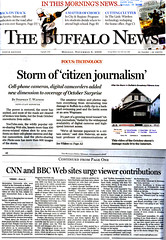
Quoted in Buffalo News about the local citizen...Image by inju via Flickr

Yesterday was interesting. Twitter once again ruled the news agenda of mainstream media (MSM) networks as the world's editors finally woke up to the fact (where have you been, CNN?) that something enormous, potentially agenda-changing and highly significant was unfolding in Iran.

From the beatings of students in their dormitories (a story that broke on Twitter, with Twitpics of damaged dorms and bruised students) through to the unfolding 'is it on is it off' drama of the march on Tehran by the green banner-waving opposition crowd (some estimates had it at 2 million and more), the news was happening on Twitter significantly ahead of coverage on the MSM.

This meant that major outlets such as CNN, ABC, Sky and the BBC were all reduced to referencing Twitter in their coverage. The actual Twitter output was massive, reaching several tweets a second going into the late afternoon, and the feeds started to get confusing with rumours spreading and people tweeting and retweeting new information almost regardless of its source. A colossal number of people used Twitter, blogs and Facebook to follow events in Iran yesterday simply because the traditional media failed so badly in understanding that we care about this news. It was a massive editorial misstep that you could argue was only avoided by the BBC which with its Persian service, was at least trying to stream live from the streets.

The news media on the ground, under-resourced, restricted and rightly fearful in the face of baton-wielding nasties in and out of uniform (Take a look at this chilling image of, I understand, government Basij militia from yesterday afternoon) simply couldn’t keep up with the flow of witnesses on the ground. Some quite organised student groups were using mobiles to text news from the crowd back to Twitterers who stayed online using their dial-up connections and switching proxy servers to keep trying to get the news through. It reminded me a little of Salam Pax, the Iraqi blogger who kept information coming out of Baghdad in the face of the American invasion and Iraqi resistance.

Problems

This stream of information from a confused, dangerous and yet highly important series of events on the ground raises a number of problems. The first of these is provenance. How do you KNOW you’re watching a Twitter feed from a genuine Iranian student and not a hoaxer or, even worse, state-owned instrument of instability. For instance, a foreign intelligence outfit could quite nicely stoke up international concern and damaging coverage by pretending to be a witness – and we’re all credulous enough to take the bait because, let's face it, we want to see social media beating up the MSM.

So how do we know you’re real?

My own personal test is a website or blog. If the Twitterer links to one of those, you have the chance to have a quick browse and test an established track record and a history of conversation. Another test is personal relationship – if someone with whom I have an established online relationship can vouch for the new contact, then I’ll usually take that as a bona fide contact. And another is longevity - I prefer sources that were online and have a track record before the events in question took place.

Keeping a cool head can be hard in the face of the excitement, but there’s nothing worse than finding yourself accused of blindly repeating BS – or being unhelpful in your attempts to help. For instance, at the height of yesterday’s events, people were retweeting lists of alternative proxies. That was cluttering up the stream and generally getting in the way. If you’re based in North America and have no Iranian friends, retweeting a proxy server with an #iranelection hashtag is hardly going to add utility to the conversation, for instance.

Some MSM pundits were pointing out that the information on Twitter wasn’t reliable. I thought it was. Following the couple of simple rules above and waiting a little to have news confirmed by multiple sources, I got compelling information and images from on the ground witness sources often hours before the broadcast media.

The other thing I found interesting about yesterday was that the audience was self-selecting. Those of us that cared – because we have Iranian friends, relations, business interests or any other tie to the events in Tehran – could select the information we wanted and decide how we wanted to receive it. We could dip into the story for an update whenever we wanted, dedicating the appropriate measure of time we all wanted to give to updating ourselves. No advertising breaks, no filler stories about Ping Pong the panda and her lovely babies and no celebrity guff about Paris Modhesh or the like (you still there CNN?) getting in the way.

Was yesterday a great day for social media? Yes. Was it a worrying day for ‘traditional media’? Without a doubt, yes. Does this mean MSM is dead? I don’t think so. But I do think it’s a very clear signal that we are in a time of immense change and if big business news organisations don’t get it together fast, they’re going to get hit, hard.

People are finding a faster, fresher, more vibrant, immediate and real source of news and information. It's other people.

Reblog this post [with Zemanta]

Monday, 15 June 2009

Who's the F***ing Superpower Here?

I, Charles Ayoub, own the image and release it...Image via Wikipedia

Many years ago I used to manage the Middle East PR account of a certain very large software company. I went to Paris for a conferency thing with them and there I met, over dinner, the general manager of their Israeli operation. It was an odd moment. Coming from very different sides of the fence (or, if you prefer, security wall), we had both spent a great deal of time managing reactions to each other’s operations in our respective markets. Initially somewhat wary of each other, we got on fine, as it turned out.

In over 20 years of working in and travelling around the Middle East, I have always tried as hard as I could to remain objective about Israel and the actions of its government. It’s been difficult at times, I have to admit. But I’m also conscious of how easy it would be to slip into an unthinkingly anti-Israeli stance when your friends and colleagues have been so caught up in the conflict and wickedness that has burned so long on the eastern coast of the Mediterranean.

My friend Jacks came back from a trip to Qana with UNIFIL carrying photographs of the burned children in the smoke-blackened remains. It’ll be a long time before I forget those. She was a nervous wreck at the time, having spent weeks travelling around Southern Lebanon. I have stood in Beirut as the Israeli jets overfly the city on one of their window smashing trips, breaking the sound barrier purposefully so that everyone underneath gets the message. I have watched colleagues reduced to tears as they try to telephone their families under bombardment. I watched in horror last year, thanks to Palestinian news agency Ramattan’s rooftop camera, as Israel pointlessly smashed its way through the ghetto of Gaza with massive military force, blotting hundreds innocents out of existence as they went.

When I wrote Olives, the second book wot I writed, I tried desperately hard to retain a sense of balance. The book’s about a journalist who gets caught up in a series of bombings in Jordan and Israel. It’s necessarily told from an Arab perspective because our man is living in Amman and falls in love with a nice local girl, but despite that I wanted to make sure that it didn’t demonise or dehumanise the people over the border. I hope I was successful in that.

I completely lost any sense of objectivity last night. Benjamin Netanyahu’s speech had me raging. An exercise in indefensible, calculated wickedness, I believe it demonstrated how incredibly out of touch Israel’s government is. There cannot be room in the world for people like that – people who will so willingly and glibly consign others to poverty and disease, despair and degradation. Netanyanhu trotted out the same awful Zionist claptrap, the same distortions that gave us ‘A land without a people for a people without a land.’ But for some reason, this time it made me angry. I think perhaps because his words are so completely out of step with any sense of justice or fairness, so totally out of touch with the mood and spirit of the time.

It’s become so entrenched in Israeli policy, this idea that you have to go to the negotiating table hard, that you’d be forgiven for thinking that Benji’s just setting the stage for a tough tussle with Barack’s boys. By resetting the border lines with the wall (so that it encompasses extensive water resources on the Israeli side), by creeping into the post-1967 areas with settlements, Israel’s continued, inexorable progress across the map of Palestine has left only a tiny area of the least viable land for any Palestinian state to occupy. And yet even now Netanyahu’s government will continue to build settlements, will continue to use their own people as tools in the Great Game, the vicious land grab that has become core to Israeli policy. Is he just squaring up for that great, final negotiation or is he genuinely so arrogant that he believes that Israel will be allowed to continue on this course? Bill Clinton’s reaction on meeting Netanyahu possibly gives us the answer to that one.

The great difference of course is that now these words are being heard by a world that has had a chance to see quite how evilly the Israeli government is willing to behave towards the people whose farms and land were appropriated in the country’s founding. The flow of information means that people around the world are more informed, have access to the other side of the story – the side that has been so marginalised for so long.

Obama’s overture to the Arab World was a major signal that the US administration understands what George Bush’s dumb hick neo-con monkeys failed to grasp. Settle the Palestinian issue and you will not only bring the prospect of wealth and hope back to the Middle East but you will defuse the extremism that has torn the region apart for so long.

Benji’s failed to grasp that one, too.

What surprises me is why Israeli students aren’t on the streets trying to get rid of their evil old men, too.


Reblog this post [with Zemanta]

Sunday, 14 June 2009

Iran Media Coverage Fail


View Larger Map

Watching Sky News over the weekend just reinforced my growing irritation with ‘traditional’ media. There’s a big bust up over budget caps in Formula One racing and Ferrari, among others, is playing hardball with F1 supremo Bernie Ecclestone – a news item repeated constantly through the weekend. At no point did anyone explain what the bust up was actually about. The repetitive coverage of the same news file means we never drill down into the story and so I end up having to Google it to find out the answers to my obvious questions - the questions, incidentally, of journalism 101 - what, where, why, when, who, how?

Similarly, there’s no analysis of Mousavi’s role in the Iranian elections, no depth on offer at all, just a number of sound bites filmed with over-excited girls in hijab. And so I have to Google him, too, to get the background I feel I need to form my opinion.

By Saturday afternoon, I've given up watching repeats of Tim and Ashish and I’m getting my Iran election news from Twitter – a good selection of opinions, breaking news and links to better and more in-depth sources than Sky. I’ve not even got a Twitterfall going on it, that’s just the commentary from Tweeple. And the Iranians among them are sharing links to articles that reinforce and deepen my knowledge of the elections, widening my horizons and engaging my (I admit, unusually active) curiosity.

Amanda Knox is standing trial for the murder of Meredith Kercher. That one’s repeated again and again, but there’s no coverage of her actual testimony. Whatever happened to the boyfriend? Again, Sky ain’t telling. Googled.

So I'm getting my news analysis from search, from Twitter and from online news sources. And increasingly I'm getting my news from these sources, too. Because Sky, an important UK news provider, simply isn't giving me the news I want with the information, intelligence and drill-down I want.

Increasingly, I’m finding that my, and others’, curiosity is finding itself satisfied by online sources and not news media. Other people are asking the same questions and the answers are easier to find online through social sites, searching news sites, using RSS. I’m getting more depth of information, a broader reach of public opinion – both international and local to the event – and talking to people about stuff as it develops.

This morning there’s a new Twitter hashtag - #CNNfail – and it's a top 'trending topic' on Twitter, a reaction from thousands of people using Twitter who are learning more about the elections and subsequent riots there from Twitter than they are from CNN - which has been apparently failing completely to cover the entire process.

As traditional newspapers continue to struggle, many depending on newswires that consumers are perfectly able to read for themselves and unable to deliver the breadth of witness, comment and opinion available to us online, I do wonder how long it will be before we finish with this pointless journalism/bloggers debate and recognise that our news media is changing in a fast and fundamental shift that will wipe out many of the less agile players.


Reblog this post [with Zemanta]

Tuesday, 9 June 2009

Warning! Phishing! Fraud! Shock! Horror!

The String Quartet Tribute to Phish album coverImage via Wikipedia

Etisalat has done it again.

Not content with sending a warning email to subscribers that contained the immortal words 'Etisalat will never email links' and that also contained (almost inevitably) two links, the telco that likes to say 'shou?' has now sent an email to its lucky subscribers further warning them of the dangers of phishing.

"Security Alert - Beware of Email Fraud Disguised as Official Etisalat Emails" trumpets the email subject line. Inside, we have a picture of a cursor pointer being snared by a barbed fish hook and the word, in red mind you, WARNING! Golly, they must be serious!

The email also contains the following words:

NOTE:Etisalat will never ask you for neither your Internet/Email passwords nor any other personal details by Email, Internet or phone. Please do not disclose any of your Etisalat services passwords to any person.

And then, inevitably, at the bottom of the mail is a link out to this online form, which asks for your name, username, telephone number and email address.

The Internet. A rich and wonderful place...
Reblog this post [with Zemanta]

Monday, 8 June 2009

Oh NOES! Modhesh is BACK!

Golly! Has it really been ten long years?

He's started to pop up around the city again, little splashes of yellow now adorn every street sign and grassy verges carry life-sized statues of the infinite-eyed one. Soon we'll be inundated with the little swine (sorry, 'beloved icon') and his unique brand of fun. And somehow I think we're going to see more of him than usual as Dubai kicks into uber-promotional mode to counter the slowdown.

Membership of that naughty Facebook group has started to rise again. I wouldn't mind taking anyone's money that it'll be over the 1,000 mark by the weekend.

We can only be grateful that they left it so late to get everything going - it's only three days until the Dubai Summer Surprises shopping festival starts and he's only just starting to pop up everywhere.

Apparently Modhesh Fun City is to become Modhesh World this year. The slightly muckle-headed announcement fails to give a location, but we can only assume the Airport Expo. This will be home, the announcement gushes, to over 37,000 square metres of fun.

I can't wait.

The My Modhesh website is currently crashing when you click on any of the tabs to the left of the home page, which is quite fun. And the DSF Website is still carrying January dates on its page heads and a January release on its home page, despite all the over-excited claptrap on there about how Modhesh is a harbinger of cheer for small children everywhere. Mind you, it could be worse. It could be 'Under Construction' like the Dubai Summer Surprises website!

They'll need to spruce those up in the next day or two, won't they?

Sunday, 7 June 2009

Mrs Google and her Five Lovely Daughters

Image representing Google as depicted in Crunc...Image via CrunchBase

Have you ever Googled yourself? Feel free to go ahead and try it. There's no shame. Everyone does it, they just don't tend to boast about it in public much.

Are you the first search result? If not, someone else owns you. Now if you’re called Amy Winehouse or Barack Obama, the chances of you doing something about it are pretty slim, but all is not lost: bear in mind most people will refine a search for a common name - with a location or profession, for instance.

Search is a funny and arcane little game, but broadly search engines prioritise sites by their popularity using a mixture of relevance, links to the site and traffic. Blogs get treated incredibly well by search engines, as does Wikipedia. If you’re mentioned on a major website or a blog, it’s likely that this mention will pop up first – the minor vertical industry website about melamine production in Kamchatka likely won’t rise to the top of the pile.

If you’re not on the first page of search results, a lot of people won’t bother going on to wherever you are to be found down the pecking order.

Why does it matter? Increasingly, you want people to find you online – because increasingly, people look for people online. A recent ‘straw poll’ we conducted over Twitter saw over 85% of respondents saying that they researched new business contacts online before meeting them. So the person you’re shaking hands with for the first time likely already has a view and opinion of you – and he/she found just what you found when you searched yourself.

Can you do something about it? Sure. Get online and join up for professional networking sites like LinkedIn. Think about how people would find you and use those phrases wherever you are interacting online or writing content for online media (‘John Smith Dubai Creative’). Give your Facebook profile a spring clean and spend a little time trying out some social media interactions.

You never know, taking a look at that search result and putting yourself in the shoes of a recruiter, potential employer, new business prospect or supplier may just be what it takes for you to start working on your online profile and investing a little time in a Google Makeover!

This piece originally appeared as one of the chucklesomely named 'A Moment with McNabb' columns in Campaign Middle East magazine. I have to put it here ‘cos they haven’t got a website yet and don’t post it to their own damn blog.

Reblog this post [with Zemanta]

Thursday, 4 June 2009

Obama in Cairo

"The history of the relationship between America and the Muslim World is deeper and more complex than the common perception might suggest. Thomas Jefferson taught himself Arabic using his own Quran kept in his personal library, and had the first known presidential Iftaar by breaking fast with the Tunisian Ambassador at sunset."

Just in case you're interested:

The Whitehouse Blog.

The Facebook Video feed for the speech, to be given at 2pm Dubai time.

I think this is potentially the most important American speech in 25 years...

(PS, the comment from brn to this post is that most embarrassing of things, a comment that's more insightful and readable than the post it adorns. Recommended reading, then!)

Wednesday, 3 June 2009

Facebook and Disaster

An Air France Airbus A320-200 landing at Londo...Image via Wikipedia

7Days, with its superior sense of news, leads with the tragic story of Ana Negra Barrabeig, the Dubai based woman who lost her life, returning from her honeymoon, on AF447. Tragically, her new husband took another flight back to Dubai as he had to return to work. Ana had planned to spend a few days with relatives in Spain on her way back.

The story is heartbreaking enough, but there's a macabre little postscript for those of us that like to follow the ins and outs of social media and its growing role in our lives.

Ana's Facebook page is still up, you see. And so journalists researching the story have been able to get details about her employer, her friends (I can only assume friends are getting Facebook and other requests from media) and also have been able to trawl through her photographs and other personal information posted up on the site.

I'd link to her page, but it feels like such a scandalous invasion. Maybe I'm being funny about it.

I had never, strangely, thought about this possibility. I have worked with media on the trail of a 'big' story on many occasions and it's always an interesting experience. The story is everything and woe betide anyone who gets in the way of it. Media will try literally anything to get that 'edge' that 'angle' - including faking sympathy, concern and trying every back door to get through to the subject.

But the media looking into AF447 had a new first port of call. They just had to Google the names of the passengers on the list and start digging into their online background. There it all is - pals, fears, hopes, photographs. Everything you'd want to get started on that story about the people who were lost.

Here's a thought, peeps. Take a look at your online self. What would you be leaving behind if, God Forbid, you were taken suddenly?
Reblog this post [with Zemanta]

Tuesday, 2 June 2009

Air Outpost


I love HDR. Official.

This might not be a technically ‘correctly composed’ shot, but it makes a smashing desktop image (if I say so myself) – drop me a mail or a Tweet if you’d like a full sized image. Nick probably won’t apply. ;)

The image was taken in a mooch around a much-loved monument; Sharjah’s Mahatta Fort Museum. If you haven’t been there, I can only urge you to go.

A nice little slice of the UAE’s history – and a little slice of British history too, is wrapped up in the story of this odd little fort.

Mahatta Fort used to be a mile from the old town of Sharjah. Today it’s enveloped in the city – but the road outside that leads from the traffic lights just down from Mega Mall past the ‘Saudi Mosque’ and through Ittihad Square to meet ‘Smile You’re Insane’ (Sorry, ‘Smile You’re In Sharjah’) roundabout is suspiciously straight and slab-like, with dribbles of bitumen infilling the slabs. There’s a reason for that – the road is actually the old runway of Sharjah International Airport, before the airport was moved out of the city.

In 1937 this runway was a sand landing strip and served Imperial Airways, the (at the time) miraculous air-route that led from Croydon to Australia – a route that traversed Europe, taking passengers to Egypt and from there either through Darkest Africa to Cape Town or through Darkest Arabia through India, Asia and down to Australasia.

This first ever attempt to create a global airway brought the whole (Sun Never Sets On It) British Empire together. It meant travelling from Croydon to the desert town of Sharjah in just four days! From South East Asia, the Imperial Airways service was handed over to the Queensland and Northern Territories Airline Service. You’ll likely recognise it better as QANTAS.

We have a copy of the documentary film Air Outpost, made in 1937 about this remarkable desert airstrip, the fort that was built by the Sheikh of Sharjah to house the 38 passengers of each flight and protect them from marauding bedouin as they made their way through from Alexandria via ‘Bahrein’ to Qwaidar in Baluchistan and on to Karachi in India. In the morning after the Alexandria overnight stop, staff would have to be despatched to the city’s brothels to round up wayward passengers. Honest.

Sharjah held no such attractions, of course...

The film itself is important, credited as being likely the first ever true ‘documentary’ film, one of a series made by director Alexander Korda for Imperial Airways by his London Films company – and featuring a soundtrack composed by William Alwyn, now recognised as an important C20th British composer. The film is preposterous in the extreme, from the quoits-chucking Brit goons playing in the courtyard of Mahatta to while away the time between arrivals through to the stiff fish carried on donkey-back from the ‘Arab city of Shar-Jar’ to serve the lucky guests. There’s even a grumpy looking Scottish station manager who signals to the Sikh walla to ring the bell announcing the arrival of the flight – using, as the instruction, the very same bell-ringing motion he could have used to damn well do it himself. The Iranian petrol-boys play cards as they wait for the flight to arrive and the Sheikh's guard of honour turns out to greet the passengers. Tally ho!

It still amuses me greatly.

The planes used to fly from Alexandria to Gaza in Palestine, and then on to Habbaniya and Baghdad by following ‘The Trench’ – a guideline laid across the black desert of Northern Trans-Jordan by trawling a bunch of chains behind a tractor. After the overnight stop in Baghdad, it was off to Basra, Kuwait, Bahrain and, finally, a landing in Sharjah as the last of the day’s light played itself out.

Imperial Airways eventually became BOAC, the British Overseas Airline Corporation and then just simply British Airways.

Sharjah airport was used to house Spitfires in WWII (A pal of my dad’s used to fly ‘em here – “What you want to live in Dubai for, boy? It’s just a bunch of mud huts on a creek!” I kid you not) and then flew commercial stuff until the new airport was built and Mahatta fell into disuse. The extensive (and fascinating) area of Nissen huts and workshop buildings that used to litter a swathe of central Sharjah was eventually cleared for development, only the broken down remains of the old fort eventually remaining. And then, wonder of wonders, it was renovated and turned into a delightful museum – which is well worth a visit, BTW.

The story of the Handley Page Heracles class biplanes, 38-seat luxury airliners decorated inside in mahogany and chintz (featuring, of course, a bar) that linked the world for the first time ever is a remarkable one that has long captivated me. It ended in tragedy when one of these great planes was lost en-route to Sharjah in the Indian Ocean, somewhere off the coast of Kalba, or perhaps in the Eastern Hajjar Mountains. Nobody is quite sure.

And that is where I end my tale. With a thought for the 228 people who didn’t make it to the runway this week, either, lost somewhere in an ocean. Where, nobody is quite sure...

UPDATE
With consummate cool, The National has posted the full copy of Air Outpost up on its website! You can find it here!

Monday, 1 June 2009

Gulf News. An Apology.

The ALSTOM Coradia Lint interurban trainset is...Image via Wikipedia

In its editorial today, Gulf News exhibits an amazing mixture of ignorance and arrogance. I'm really not sure which is greater.

The paper's rant, the second* most idiotic piece of editorial comment I can recall in 15 long years of regular GN readership**, asserts that French company Alstom is 'defying international law' - presumably because it is working with the Israeli government (GN's madcap scribble asserts 'by seeking financial gains at the expense of justice and peace') on the Jerusalem railway project.

The paper then goes on to say, of Alstom, 'It must reconsider its position, and so must regional states that deal with the French company.'

States like the UAE, for instance?

  • The 2,000 megawatt $2 billion Fujeirah power plant contract awarded by the UAE in August 2007? Or the 16-year maintenance contract for that very same plant it signed in 2008?
  • The February 2006 $250million Dubal power plant contract? Or the power plant and fume treatment contracts with Sohar Aluminium Company and ALBA (Aluminium Bahrain)?
  • The August 2007 contract for a $175 million 150Megawatt co-generation plant at Dubai's aluminium smelter, DUBAL?
  • The June 2008 award of a $500mn tram network in Dubai (together with consortium partners Besix and Serco)? The Al Sufouh tramway is apparently under construction.

In fact, the most cursory search of Gulf News' own website reveals a long history of huge contract awards to the company in the UAE and the wider Middle East, with key and strategic elements of transport, power, water and other public infrastructure being supplied and maintained by the company across the entire region.

So what's the answer here? Are we really being subjected to the ranting of simian, gibbering idiots - or is Gulf News knowingly misleading its readers as to the extensive and ongoing dealings which the UAE and other Middle East governments have with this major multinational company?

Does it owe its readers an apology for its ill-considered and badly researched coverage of this issue? Or an apology for being craven in its 'clarion call'?


* The most idiotic award still belongs to the holocaust denial piece, which seems to have been taken down from GN's website.

** Jeepers. That's over Dhs 16,000 at today's rates! I want a refund!


Reblog this post [with Zemanta]